A while back, I worked with a group of my friends to film part of a music video. We used a Canon Rebel T3i and a rolling tripod. I wasn’t responsible for the cinematography aspect of that video, and therefore did not get to handle the camera very much. However, I was present every time my group was filming, so I was able to see the struggles our cinematographer (Ryan) faced. He struggled a lot with the camera maintaining focus; it kept going in and out of focus, even with the slightest movement. It was also difficult to see what he filmed immediately after filming it because the screen with the camera was so small. Our video (see below) still turned out great, however the process would have been much smoother without these complications.
Music Video
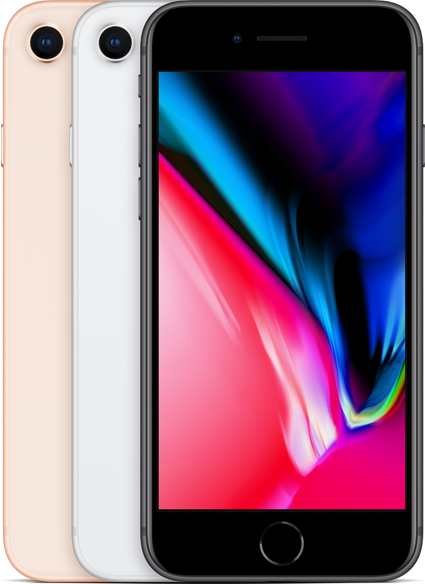
iPhone 8
This is why I’ve chosen to film my title sequence using my iPhone 8. My iPhone camera autofocuses, which will be a huge help during the filming process. iPhone cameras are also compact, so transporting them to and from shooting locations will not be a challenge. Here’s a list of some other benefits an iPhone camera includes:
4K video recording at 24 fps, 30 fps, or 60 fps
1080p HD video recording at 30 fps or 60 fps
720p HD video recording at 30 fps
Optical image stabilization for video
Quad-LED True Tone flash
Slo-mo video support for 1080p at 120 fps and 240 fps
Time‑lapse video with stabilization
Cinematic video stabilization (1080p and 720p)
Continuous autofocus video
Take 8MP still photos while recording 4K video
Playback zoom
Video formats recorded: HEVC and H.264
Sound
I plan to use my iPhone camera to record as much sound as I possibly can, but I will definitely go back during post production and record more sound. My title sequence has no dialogue, so I don’t have to worry about recording that. I will mostly have ambient sound.
Here are my production design ideas for my project.
Lighting
from Eighth Grade
Most of my title sequence will be high-key lighting. However, at the beginning when she is just waking up, I want to use low-key lighting. Not in a creepy way, but in a it’s-the-morning-and-my-room-is-dark way. Here’s a screenshot from Eighth Grade (2018) that shows the sort of lighting I’m talking about. Notice how it’s only dark because it’s early, not because it’s scary. Other aspects of mise-en-scene will help with this as well.
Costuming
I want my main character to dress sort of in a “funky” way. I want her to look disheveled and mismatched. This will add to the comedy element of the sequence. I’ve included images of Nadine from The Edge Of Seventeen(2016) to show the sort of vibe I’m looking for.
Decor
the bedroom
In an earlier blog post (found here), I discussed where I will be shooting and also included some images. I will be including lots of posters/wall decor, scattered clothes, hair products, jewelry, and other random objects in the scenes that take place in my character’s bedroom.
the bathroom
When she is in the bathroom, I will have a bunch of hair products, makeup, and soaps everywhere. I want it to look like a mess because that will add to the chaotic nature of the title sequence. I also enjoy the blue patterns on the shower curtain, as they tie in with the blue sheets and comforter on her bed.
When she is in the living room/ kitchen, It will look similar to the way it looks in these images. I don’t feel the need to change much, since my character will only be here for a short period of time. The only changes will be the placement of the props.
I won’t be manipulating the school setting either. I will be including our student parking lot, stairs, hallways, and our of our classrooms. Lockers, desks, and the styles of our classrooms will be effective decor elements for my title sequence.
Props
Here is a list of the props I will be using and their purposes. It is possible that I will change these out or eliminate some.
Phone: used as alarm.
Toothbrush, face wash, hairbrush, mascara, sneakers: to show the panicked state she is in by using these props in a frantic manner.
Granola bar, car keys, backpack, car: to show she is on-the-go.
Sources
I used various IMDB links throughout this post. Their specific URLs can be found when clicking on them.
For my film opening, I am going to need two separate settings. I’m going to need a home setting and a school setting. I will need to include a teenager’s bedroom, a bathroom, kitchen, and driveway, as well as a school parking lot, various hallways (for my montage), and a classroom. I will be using my friend Taylor’s house for the bedroom, bathroom, kitchen, and driveway scenes. Her house has a lot of the mise-en-scene that I want already there, which means less work for me when it comes to production design. Below are some images from Tay’s house that I plan to use.
For the school scenes, I will use my high school. I’m familiar with the lay out of the school and I’ve filmed here before when I had to create a music video. I have experience working in this environment and see it as a great setting for my film.
Actress
she has a bird on her head
us doing our volleyball handshake
she’s adorable
I’ve selected my BEST FRIEND Taylor Moore to be my actress. She will be the perfect lead actress because she’s ADORABLE and fits the vibe of my film really well. I mean just LOOK AT HER.
Scheduling
me at Taylor’s house on Saturday
Since I’m heavily relying on Taylor and her house, I need my filming schedule around her life schedule. Taylor is also taking Media Studies, so she also has to film a title sequence. She has asked me to be in it, which means we will have to schedule around each other, or come up with a way to work with each other. We’ve decided to film at her house this upcoming weekend (2/23-2/24). This will provide us with plenty of time to complete both of our projects. I will get the school scenes filmed throughout the week of 2/25-3/1. I will complete my rough cut by 3/4 and THEN I will begin the editing process!
After conducting all this research and beginning the outline for my project, I wanted to take a breather and reflect on what the past month has taught me and how I feel about what is to come.
Deadlines
me thinking about all the stuff I have to do
One of the biggest things I’ve learned throughout this process is that deadlines creep up fast. I began this project in January and I’ve struggled to remain on-pace. In my introduction blog post, I set out a schedule for when I wanted things to be completed. I wanted my research done by 2/3, however I didn’t complete this until 2/7. Scriptwriting and funding was supposed to have been completed by 2/10, but I didn’t finish it until 2/15. My preproduction completion date is 2/24, however because of my working shooting schedule it will have to be completed earlier. Because I am basically 5 days behind schedule, this is going to be a very difficult deadline to meet. It’s doable, but it’s not going to be fun. I also have to keep in mind that my rough cut is due by 3/3.
Shooting Stress
accurate representation of me thinking about all of this
I HAVE TO SHOOT MY TITLE SEQUENCE NEXT WEEKEND. I AM FREAKING OUT. Like I said before, I haven’t completed my preproduction phase, which includes storyboarding, aspects of mise-en-scene, determining a shooting location, finding an actress, and so much more. I have ideas for all of these things, but I haven’t actually done it yet. Scheduling is going to be a big problem for me when it comes to my actress and my shooting location, but I will go more into that in future blog posts. I am super nervous something is going to go wrong when it’s time to film, but I guess that’s part of the process.
Overall, I’m nervous and excited for what is to come in the following weeks. I want my project to look great, which is going to require hard work and lots of time. Wish me luck in the coming weeks!
I’ve started to shape my idea for my final title sequence. Like I said in my film pitch, A Lot To Learn is a comedy/coming-of-age story that will follow seventeen year old Aspen through the worst week of her life. It is set in Wesley Chapel, Florida and will focus on her desire to leave town. A central part of the story arc is the comedic dynamic between Aspen and her math teacher, Ms. Jennifer Graves. Below is an outline for what shots, editing techniques, and sounds I want to include. Astricks (*) indicate shots that I want to try and film, but I am not sure if including them will work.
Fade in close-up shot of the main character, Aspen. The sound of an alarm clock is also fading in to represent her regaining consciousness. Her eyes open slowly to show she is waking up. The sun needs to be up; she slept through her alarm.
The shot switched to an eye level/slightly low angle shot of her grabbing her phone, checking the time, and turning off her alarm. Her eyes widen.
***Long shot of her falling out of bed.
Long shot of her opening her door and running to the bathroom to brush her teeth and get ready. Her hair is disheveled and she looks like she just woke up (because she did). *Debating whether or not I want to do this as a tracking shot instead of a stationary shot.
Close up shot of her brushing her teeth OR over the shoulder shot with the mirror in focus.
***Extra Shot: Her washing her face.
Mirror POV shot, center framing, of Aspen frantically brushing her hair and looking concerned.
Close up of her putting on mascara frantically. Possibly leave a glob of mascara on her lid for the rest of the clip.
Medium close up shot of Aspen putting on a sweater (?) over a tank top.
Close of of her shoving her feet into sneakers OR long shot of her pulling them on and hopping around.
If I use the last shot described, I will also film her snatching up her keys. If not, I will film her running through the kitchen, grabbing a granola bar and and her keys. There will be insert close up shots of her hand grabbing the keys and the granola bar and her backpack.
Long shot of her exiting her house in a hurry. Shows her fumbling with and dropping her keys. Would need to record sound of keys falling.
***Insert shot of her dropping keys and locking door frantically.
***Tracking shot of her running to her car?
Ground level shot of her car tires pulling out of the driveway. This is hard to explain, so in future blog posts, I will include examples of what I mean by this.
***Possibly include crosscutting between a red traffic light and Aspen in her car looking impatient and desperate for it to turn green? This might be too much to accomplish.
The same sort of ground level shot will be used in the school parking lot when Aspen arrives. She will pull into the parking space; I may add the sound of tires squealing?
Montage of tracking shots of her walking to class through hallways, doors, and upstairs.
Final shot will be an eye-level shot. At first just part if the desk and the chair will be in focus. The classroom door opening will be out of focus but still visible. Aspen will not be in focus until she sits down in her chair. She should seem out of breath.
As of right now, I don’t know if I want her to be on time for class or late. This decision will effect whether or not there are other people in the hallways at the same time as her and whether or not I have to record ambient sound of other people in the hallways. I feel generally confident with my outline, however I am concerned I don’t have enough shots to keep up with the fast pace I have in mind. We’ll see!
After conducting extensive research on coming-of-age comedy films, I’ve noticed that they are often advertised primarily as comedies, which makes sense because comedies appeal to a wide variety of audiences. Coming-of-age is a sub-genre of comedy films, and this is exactly how it will be implemented in my final project. I want my film to make people laugh, but I also really want the entirety of my film to dive into more serious matters and leave a lasting impression on the audience. I also want my film to have an indie-vibe rather than a large-studio vibe. I feel like that sort of look fits the themes of my film better.
I’ve decided to pitch my film to A24. This production and distribution company specializes in indie films and excels at producing the genre I’ve chosen for my final. I am confident they will help me successfully achieve the vision I have in mind for my film. I conducted through research on A24 before making this decision, which can be found here.
Included above is a video I made where I pitch A Lot To Learn to Daniel Katz, one of the CEOs and founders of A24, and his team. In it, I go over a brief summary of my film, why I chose to pitch to A24, and my budget. Soon after submitting my proposal, I received a response (from my teacher HA).
I’ve been thinking about which production and distribution company I want to pitch to. I’m leaning towards A24 because I’ve seen a few of their movies and they have a similar vibe to the one I want my film to have. However, I conducted more research to see if they were the right fit.
About A24
A24 logo
A24 is an independent New York based production and distribution company that was founded in 2012 by by Daniel Katz, David Fenkel, and John Hodges. In its early days, it was only a distribution company. Its first box office hit was Spring Breakers (2013), followed by Ex Machina (2014), Room (2015), and The Witch (2015). More recently they have produced and distributed films such as Moonlight (2016) and Eighth Grade (2018). They began streaming their movies on Amazon Prime Video and DirectTV Cinema in 2013. As one of my sources said,“A24’s business model appears to be trusting bold filmmakers to do their best work, then figuring out how to sell it.” This approach is very unique, since most film businesses focus on what’s going to make the most money rather than artistic value.
A24 award nominations compared to larger companies
Because of this approach and their effective campaigning, A24 distributed films are often considered for awards such as Oscars. Above is a graph I found in one of my sources that compares A24’s Oscar and Film Independent Spirit award nominations to larger production/distribution companies. As you can see, they do pretty well for an indie company. This shows their effectiveness as a company when it comes to marketing a film to critics, which in turn helps their films gain popularity and entices general audiences to watch.
Why A24?
from Never Goin’ Back
A lot of the movies involving A24 have a distinct indie-feel to them that I really like and want my film to have. Bigger studios don’t have this feel, which is why I won’t be using a large production company. They have produced and distributed similar films to my own, such as Lady Bird (2017), Eighth Grade (2018), and Never Goin’ Back (2018). Because of this, I feel like they have enough experience with this genre to effectively produce, distribute, and market this film.
Amazon Prime Video logo
I think the best way to release A Lot To Learn would be via platforming. Lady Bird did this very successfully (see my post “It’s Given To Me, By Me.”) and I think this method has the potential to reach a smililar level of success with my film. If it is successful, it can be released to more theater chains. After a brief theater run, my movie will be available for streaming via Amazon Prime Video, since A24 has a contract with them. Most audiences will be viewing my movie through this platform.
I’ve decided to research a movie similar to mine that has been through the business side of filmmaking in order to generate some ideas for how I want to produce, finance, and distribute my film. I chose Lady Bird (2017), which was written and directed by Greta Gerwig. It was produced by A24,Scott Rudin Productions, and Entertainment 360. It was released on November 3, 2017 and distributed in the US by A24.
Early Stages
Greta Gerwig
The first draft of the script for Lady Bird was 350 pages long and had a totally different name: Mothers and Daughters. Director Greta Gerwig spent several years editing the script down to 200 pages and changing the title. She then askedher manager (Evelyn O’Neill at Management 360) if she would be willing to produce the film. Despite not having any prior producing experience, O’Neill accepted the role. Both of them began meeting with various producers and financers, as well as giving the script to select writers. Through this process, they obtained enough financing to account for a $10 million budget.
Production
Gerwig directing lead actress Saoirse Ronan
While $10 million seems like a lot of money, it wasn’t enough for Gerwig and her crew to shoot on location. They ended up shooting at the outskirts of LA, a single-story home in Van Nuys, and Catholic school in Pasadena. Production on the film began in August 2016 and proceeded mostly on schedule. According to my sources,”Gerwig turned out to be a machine when it came to keeping on track, leaving little room for time-wasting improvisation.”
Exhibition
Gerwig interviewing
Lady Bird used platforming as it’s method of exhibition, premiering at the Telluride Film Festival on September 1, 2017 and at the Toronto International Film Festival on September 8, 2017. Like I said earlier, Lady Bird was released to four theaters in New York and Los Angeles on November 3, 2017. The film grossed $364,437 opening weekend, with an average of $91,109 per theater. It was released to more theaters and made a total of $78,928,896 worldwide.
Interesting Facts
Gerwig worked closely with cinematographer Sam Levy in order to build a 110-page shot list that included blocking for every scene.
“Every bit as important as the settings was the soundtrack, and Gerwig toiled to assemble just the right playlist of early 2000s music. “No one in Sacramento knew who The Kinks were,” she says of her hometown’s lack of a counterculture. She leaned on Counting Crows, early career Justin Timberlake and Dave Matthews, whose hit “Crash Into Me” plays throughout the film. Gerwig also constructed an on-set playlist of ’90s and ’00s bangers, including selections from Blues Traveler and Alanis Morissette, that she would play in between shot setups.” (an interview with Gerwig, linked below)
“If these men — because it’s mostly men that have the money to make movies — had daughters or were raised with sisters, they totally understood the movie. They were like: ‘Yup, that’s my wife and my daughter.’ Or ‘That’s my sister and my mom.’ If they [didn’t], they would say, ‘Oh, do women really fight like that? Weird.'” Greta says in an interview.
After researching some common representation issues found in films in my genre, I decided that in order to fully understand how representation is portrayed I needed to analyze a scene from within the movie; not just the opening sequence. This excerpt from Clueless (1995) gives the audience the impression that women are emotional, superficial, and stupid, while it portrays men to be insensitive and immature, yet somehow still in control over the situations they are in.
Mise-en-Scéne
Various elements of mise-en-scene are used in the excerpt from Clueless in order to show gender representation. When the excerpt opens, we see Cher wearing a bright yellow shirt with a matching cardigan and a white tank top underneath the cardigan. We also see her friend Di, who is wearing a black and white skirt with a matching blazer, a red shirt, and a very prominent white and black hat. Their hair and makeup are simple, yet beautiful. The women clearly care about their appearances. This directly contrasts with Di’s boyfriend, who is wearing jeans that sag so low you can see his underwear and a green beanie. He doesn’t look as presentable as the women, which shows that he doesn’t care at all about how he looks.
from Clueless
The blocking in the debate class scene shows Cher to be at the front of the class, which the rest of the class watching her speak. Cher fills the frame with her confidence, however this blocking is meant to be ironic. Cher sounds ridiculous when she is debating, and by showing the rest of the class together and her separate, it gives the impression that she is being laughed at for her stupidity.
from Clueless
The most important prop in this clip is the report card, which Cher claims to have received a C- on. This shows that she isn’t the brightest, which adds to the idea that women are stupid.
Cinematography
As for cinematography, a high angle over the shoulder shot was used to when filming Di in the conversation between her and her boyfriend. This shows Di to be inferior to her boyfriend. A low angle over the shoulder shot was used in this same scene when filming her boyfriend. This shows that he is in control of this situation. Based on the elements of costuming mentioned earlier, it is clear that he is too immature to even dress nicely. So it is kind of odd to see him in control/having power over another person. This use of high/low angle shots also makes women appear weak.
from Clueless
The push in on Cher when she is debating is kind of ironic. Usually push ins indicate some sort of revelation, but when we are watching Cher and listening to what she is saying, we are not getting that “Aha!” moment; in fact, we begin to see her as kind of stupid.
Editing
from Clueless
The editing in this clip during the debate scene helps to create the ideas of gender listed above. It begins with Cher, who is speaking in front of the class. Then the clip cuts to the class, who is clearly not paying attention to what Cher is saying. Then the editing takes us back to Cher, who is continuing to speak (these cuts could all be considered match cuts because they preserve continuity in the scene). Then it cuts to the male teacher, who is clearly unimpressed with Cher’s speech. Finally, it cuts back to Cher who is finishing her tangent, and then back to the class, which erupts with applause. The match cuts used in this clip, especially the cut to her teacher, serve to further the assertion that Cher, while seeming confident, clearly has no idea what she is doing. This emphasizes the point that women are stupid.
Sound
from Clueless
Dialogue is the most useful aspect of sound employed by this clip. Cher’s friend Di says to her boyfriend,”I do not wearing polyester hair!” and “…cheap Kmart hair extension”. This gives us the impression that she is superficial because she is judging things based on their apparent quality. Di’s boyfriend says to her,”Is it that time of the month again?” and the male teacher tells a student,”Could the suicide attempts be postponed until next period?” These lines of dialogue show that men, who are in power over the relative situations they are in, are insensitive and even demeaning.
I decided to do some research on the types of titles and fonts found in coming-of-age comedies, as well as how different groups of people are represented.
Titles
The generally accepted order of titles is:
from Mean Girls
Name of the distribution company
Name of the production company
“A (producer’s name) Production.”
“A (director’s name) film.”
from Mean Girls
Starring…(starting with the lead actor/actress, then followed by the most important supporting cast)
Featured cast members
The title of the movie
Casting by…
Music by…
from Mean Girls
Production designer
Editor
Director of photography
Producer, Produced by…, Executive Producer
from Mean Girls
Based on the…(not applicable to my project)
Written by…
Directed by…
This order can sometimes be changed so that the distribution company, production company, and title of the film go first and the rest follows, or so that the title of the film is last. I will go back to this post when editing my film so I know what order to put my titles.
Fonts
When introducing the title of a coming-of-age comedy film, simple fonts in bright colors on black backgrounds. A few of the words are often bolded, but not all of them. None of the fonts have “tails” on the ends of their letters, which means they are using a sans serif font. The letters aren’t usually handwritten in coming-of-age comedies, but in just comedy films, sometimes handwritten, blocky fonts are used. Juno (2007) uses very animated and handwritten fonts, while the title sequences that I did in-depth research on use simple fonts (see above). I also noticed that the fonts used in title sequences don’t use lowercase letters; they are all capitalized. I don’t like the look of handwritten fonts, so I will be using a modern sans serif font, such as Dosis. I really enjoy the simplistic look of all capitalized titles, so I will be using this in my title sequence.
Representation
from Legally Blonde
Most comedy movies make fun of common gender, race, and class stereotypes. They often make women, races other than white, and the wealthy appear unintelligent. One way films do this is through a “dumb blond” female character, such as Cher in Clueless (1995), Elle in Legally Blonde (2001), and Karen in Mean Girls (2004). Women are often the target for sexual jokes that would be considered sexual harassment if they were said in the real world. The “male gaze” is a concept that is heavily used in order to make these sexual jokes. Comedies often make black and hispanic characters seem “ghetto”, violent, and poor while asians are shown to be nerdy.
from Lady Bird
Representation in coming-of-age movies is slightly more complex. In coming-of-age films with female leads, the “coming-of-age” part often focuses on a woman coming into her sexuality. They often do this after being used by a male romantic partner, which shows women that this is the only way to be comfortable with who they are and shows men that’s it’s okay to use women. There is also a clear distinction between economic classes in coming-of-age cinema; the protagonist is either poor (like in Lady Bird) or rich (like in Clueless). Like comedy films, the wealthy are often portrayed as stupid.






 A Lot To Learn